
SBP Raises Policy Rate by 50 Basis Points to 12% Amid Rising Inflation Risks
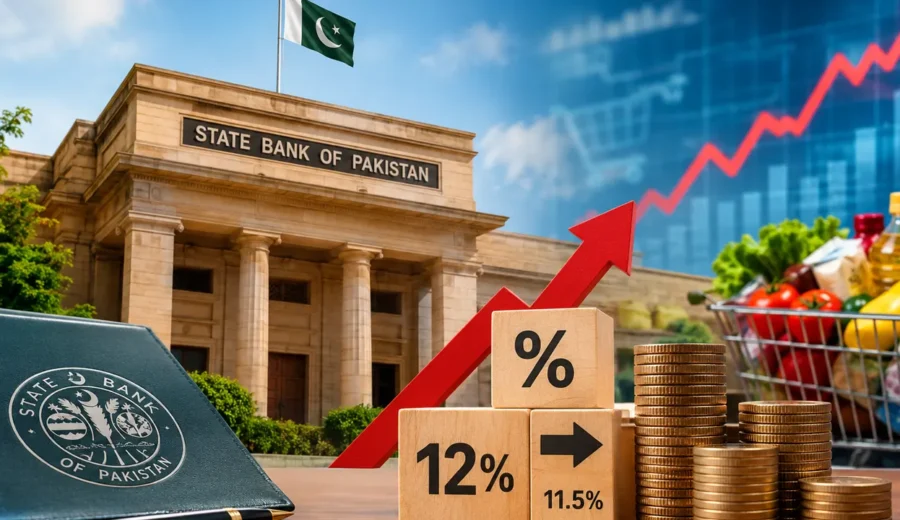
The State Bank of Pakistan (SBP) has raised its policy rate by 50 basis points to 12%, citing rising inflation risks linked to escalating tensions in the Middle East and persistently high global energy prices.
According to the Monetary Policy Statement issued on October 26, 2026, the Monetary Policy Committee (MPC) approved the increase with nine of its 10 members voting in favour. The revised rate will take effect on October 27, 2026.
The central bank said the decision was necessary to keep inflation expectations under control, limit the wider impact of rising supply costs and bring inflation within its target range of 5% to 7%.
The SBP noted that the impact of the global energy price shock on Pakistan’s economy had remained contained so far, supported by monetary policy adjustments and fiscal discipline. However, the worsening geopolitical situation has increased inflation risks compared with the central bank’s previous assessment.
Middle East Conflict Raises Inflation Concerns
The MPC said the intensification of the Middle East conflict and limited prospects for an early resolution were keeping global energy prices elevated.
Pakistan’s headline inflation reached 10.3% year-on-year in September, higher than the MPC had expected. The central bank attributed much of the increase to elevated energy and wheat prices, along with prices of related wheat products.
Core inflation also remained high at around 8.4%.
The committee warned that continued increases in food and energy prices could push inflation expectations higher and eventually feed into core inflation.
Other risks include further geopolitical tensions, volatility in international commodity prices, unexpected changes in energy tariffs, higher wheat prices and adverse weather conditions.
The SBP said maintaining a sufficiently positive real policy rate, based on the forward inflation outlook, was important to bring inflation within the target range over the medium term.
Economic Growth Expected at 3.5% to 4.5%
Despite inflationary pressures, the central bank expects Pakistan’s economy to continue recovering during fiscal year 2026-27.
The MPC retained its real GDP growth forecast of 3.5% to 4.5% for FY27.
Large-scale manufacturing (LSM) output grew by 1.9% year-on-year during July and August FY27, compared with marginal growth of 0.4% during the fourth quarter of FY26.
Other indicators, including cement and petroleum, oil and lubricants (POL) sales, private-sector credit and the Purchasing Managers Index, also pointed towards improving economic activity.
The central bank said initial estimates for Kharif crops were better than anticipated, improving the outlook for agriculture. Indicators related to information and communication technology exports, import volumes and services-sector business confidence also suggested gradually improving prospects.
However, the growth outlook remains vulnerable to a further escalation of the Middle East conflict and adverse climate events amid worsening El Niño conditions.
Current Account Deficit Reaches $874 Million
Pakistan recorded a current account deficit of $874 million during the first quarter of FY27.
According to the SBP, exports are recovering, supported by rice, high-value-added textile products and services exports. Workers’ remittances have also remained resilient and are expected to exceed earlier projections.
At the same time, imports have risen sharply, particularly non-energy imports, reflecting the gradual economic recovery and higher prices.
The MPC expects the current account deficit to remain within its earlier projected range of 0% to 1% of GDP during FY27.
The central bank said higher financial inflows, alongside the expected external account performance, could help increase its foreign exchange reserves beyond their current level.
However, elevated global commodity prices, tighter international financial conditions and supply constraints continue to pose risks.
Foreign Exchange Reserves Reach $21.5 Billion
The SBP said its foreign exchange reserves remained stable at around $21.5 billion, supported by continued foreign exchange purchases. The reserve level was equivalent to approximately three months of import cover.
The MPC also noted that Pakistan had reached a staff-level agreement with the International Monetary Fund (IMF).
The central bank said the country’s external and fiscal buffers needed to be strengthened further to improve its ability to withstand repeated global supply shocks.
It emphasised that a prudent combination of monetary and fiscal policies, along with timely structural reforms, would be important for maintaining economic stability and supporting sustainable growth.
FBR Exceeds First-Quarter Revenue Target
The Federal Board of Revenue (FBR) recorded 7% year-on-year growth in tax collection during the first quarter of FY27, exceeding its target by Rs33 billion.
The MPC assessed that Pakistan’s overall fiscal and primary balances remained in surplus during the quarter, supported by a substantial transfer of SBP profits and contained government expenditure.
However, the central bank warned that the escalation of the Middle East conflict had made fiscal management more challenging.
It called for continued fiscal discipline, a broader tax base, stronger revenue mobilisation and faster implementation of structural reforms.
The committee said prudent fiscal management remained essential for preserving macroeconomic stability.
Private-Sector Credit Growth Reaches 14.1%
Broad money, or M2, growth increased to 12.7% year-on-year as of October 9, compared with 11.4% on August 28.
The SBP attributed the increase to growth in its net foreign assets, supported by higher foreign exchange reserves.
Meanwhile, growth in net domestic assets slowed amid continued fiscal consolidation and increased external financing. This reduced the government’s net borrowing from the banking system and created additional room for banks to lend to private businesses.
Private-sector credit grew by 14.1% year-on-year, with lending spread across working capital, fixed investment and consumer financing.
Major borrowing sectors included textiles, wholesale and retail trade, and agriculture.
The MPC expects private-sector credit to maintain its momentum as economic activity improves.
SBP Emphasises Continued Economic Reforms
The policy rate increase reflects the central bank’s assessment that inflation risks have intensified even as Pakistan’s economic recovery continues.
While growth, exports, remittances and private-sector lending show signs of improvement, higher energy and food prices remain significant concerns.
The SBP said strengthening external and fiscal buffers, maintaining prudent monetary and fiscal policies, and implementing structural reforms would be necessary to protect economic stability and support sustainable growth.
RELATED STORIES