Pakistan Opens Central Plant Quarantine Laboratory to Support Agricultural Exports
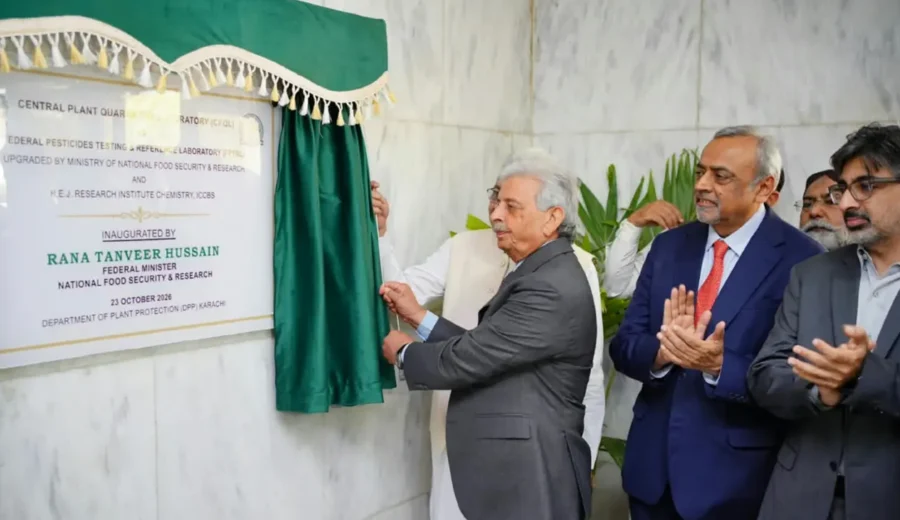
Pakistan has inaugurated a new Central Plant Quarantine Laboratory (CPQL) in Karachi to strengthen plant health testing, improve agricultural quality standards and support the country’s export potential.
Federal Minister for National Food Security and Research Rana Tanveer Hussain inaugurated the facility at the Department of Plant Protection on Friday, October 23, 2026. He said the laboratory would strengthen agricultural research and expand Pakistan’s capacity to meet international plant protection and testing requirements.
Addressing the media, the minister said the facility was equipped to meet international standards and would improve testing capabilities for the agricultural sector. He added that protecting farmers and improving the competitiveness of agricultural products in international markets remained key priorities.
Improved Plant Quarantine and Testing
Rana Tanveer Hussain said the number of interceptions had declined from 376 to 23, expressing confidence that stronger laboratory facilities and technical expertise would help bring the figure down further. The announcement did not specify the period or type of interceptions.
The minister also said the Department of Plant Protection would be able to recruit and train qualified personnel to operate the new laboratory and the Federal Pesticides Testing and Reference Laboratory (FPTRL) effectively.
The new facility is expected to strengthen plant quarantine and pesticide testing capacity. These functions are important for checking agricultural products and supporting compliance with the requirements of export markets.
Research Cooperation with University of Karachi
The minister also announced an agreement with the International Centre for Chemical and Biological Sciences at the University of Karachi’s H.E.J. Research Institute of Chemistry.
Under the collaboration, the Department of Plant Protection will gain access to commercial pesticide-residue testing facilities. This cooperation is intended to support food security, agricultural quality assurance and export compliance.
Pesticide-residue testing can help determine whether agricultural products meet applicable safety requirements in destination markets, helping exporters address regulatory standards.
Government Reviews Wheat and Sugar Markets
The minister also discussed wheat and sugar market conditions, stressing the need for coordination among federal and provincial governments, farmers and industry stakeholders.
He said decisions would be based on available data and the wider interests of the agricultural economy. Regarding sugar exports, he said Pakistan currently had a surplus that could benefit farmers, but accurate information about domestic demand was necessary before decisions on imports or exports.
Rana Tanveer Hussain also said Prime Minister Shehbaz Sharif had called for a new data-collection system to improve agricultural planning and policy decisions.
He reaffirmed the government’s stated commitment to food security, farmers’ welfare and sustainable agricultural development, adding that stronger agricultural institutions could help expand export opportunities.
RELATED STORIES