EU Ambassador Briefs Pakistan Textile Council on GSP+ Requirements and Export Challenges
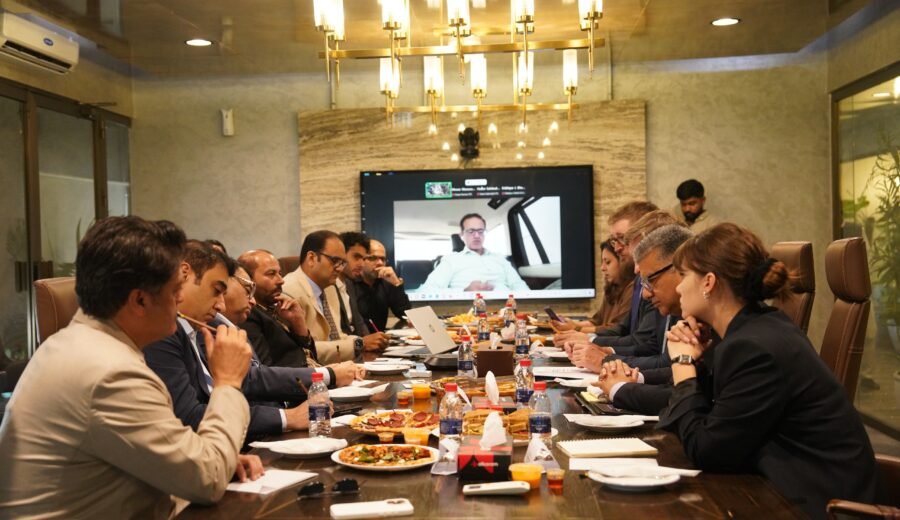
KARACHI, October 21, 2026: European Union Ambassador to Pakistan Raimundas Karoblis met with the leadership of the Pakistan Textile Council (PTC) in Karachi to discuss Pakistan’s Generalised Scheme of Preferences Plus (GSP+) status, upcoming requirements under the next phase of the arrangement, and the competitiveness of Pakistan’s textile and apparel exports.
The meeting focused on the importance of continued preferential access to the European market and the steps required to meet the EU’s expectations on human rights, labour standards, environmental protection and governance.
The EU Ambassador was accompanied by members of the EU Delegation to Pakistan, while the PTC delegation was led by Chairman Fawad Anwar. The delegation included representatives of leading textile and apparel businesses, including Gul Ahmed, Alkaram Towels, Naveena Group, Utopia Industries and AGI Denim.
EU Stresses Effective Implementation of Existing Commitments
Ambassador Karoblis highlighted the importance of the EU market for Pakistan’s exports, noting that textiles and clothing account for approximately 70 to 76 per cent of Pakistan’s exports to the European Union.
Referring to the European Commission’s assessment of Pakistan under GSP+, covering 2023–2025 and published on July 16, 2026, he stressed that progress on human rights and the rule of law would remain important for Pakistan to secure benefits under the next GSP+ framework.
The Ambassador clarified that the EU was not introducing new standards. Instead, the focus would be on the effective implementation of commitments Pakistan had already undertaken under relevant United Nations conventions.
He said the European Commission would engage more closely with the Government of Pakistan. Initial efforts would focus on demonstrating short-term improvements in areas of concern, followed by a credible action plan containing specific measures, timelines and measurable performance indicators.
The new framework places greater emphasis on implementation and tangible results rather than simply ratifying conventions or adopting legislation. The Ambassador acknowledged Pakistan’s stated willingness to cooperate at the highest level and emphasised the need for sustained coordination across ministries and working-level institutions.
Textile Industry Warns of Growing Competitive Pressure
PTC Chairman Fawad Anwar said the Council’s members were predominantly value-added exporters with significant exposure to the European market. He stressed that continued GSP+ access was important not only for textile and apparel exports but also for employment, tax revenues and the wider business ecosystem linked to the sector.
Anwar also highlighted the competitive challenges arising from the EU-India Free Trade Agreement, noting that Pakistani exporters could face additional pressure even if Pakistan retains its GSP+ status.
PTC Vice Chairman Anees Khawaja observed that the EU assessment acknowledged progress across four areas: human rights, labour, the environment and governance. He also invited the Ambassador to visit Multan to see how GSP+ had contributed to employment, livelihoods and economic opportunities in smaller cities.
Zaki Bashir, CEO of Gul Ahmed, urged the EU to distinguish between national-level findings and conditions within Pakistan’s textile and apparel export sector. He said industry-specific practices and progress should be considered when assessing the sector.
PTC members also shared examples of practices adopted by export-oriented manufacturing facilities, including certified industrial operations, female workforce participation exceeding 70 per cent at certain sites, and established worker committees.
Industry Seeks Clarity on Emerging EU Regulations
PTC CEO Muhammad Hasan Shafqaat highlighted the need for clearer guidance and proportionate implementation of emerging EU regulatory requirements, particularly the Digital Product Passport and supply-chain due diligence obligations.
He noted that these requirements could extend transparency and traceability obligations throughout the supply chain, potentially reaching back to the farm level.
The Council stressed the importance of helping Pakistani exporters understand and prepare for these requirements to maintain access to international markets and protect their competitiveness.
PTC Announces Four Steps to Support Pakistan’s GSP+ Process
Following the meeting, PTC reaffirmed its commitment to supporting the Government of Pakistan through policy engagement, technical assistance and coordination with industry stakeholders. The Council outlined four key actions.
1. Engagement with the Federal Government
PTC will approach the Prime Minister’s Office, the Ministry of Foreign Affairs and the Ministry of Commerce to share the meeting’s outcomes and present the industry’s recommendations.
2. Support for Government Coordination
The Council will support government efforts to coordinate the GSP+ process, including through a dedicated senior focal point. It has also offered industry expertise, technical assistance and support in engaging relevant consultants.
3. Industry Representation in the GSP+ Reapplication Committee
PTC Chairman Fawad Anwar, who is a member of the government committee reviewing the GSP+ reapplication process, will present the textile and apparel industry’s concerns and recommendations during the committee’s deliberations.
4. Assessment of the EU-India Free Trade Agreement
At the request of the Ministry of Foreign Affairs, PTC is preparing an assessment of the potential economic impact of the EU-India Free Trade Agreement on Pakistan’s exports. The findings will be shared with the Ministry of Foreign Affairs, the Prime Minister’s Office and the EU Delegation to support policy discussions.
PTC Reaffirms Commitment to Protect Export Competitiveness
PTC thanked Ambassador Karoblis and the EU Delegation for the briefing and constructive discussions on Pakistan’s GSP+ process.
The Council reiterated its willingness to work with the European Union and the Government of Pakistan to support timely implementation of required measures, safeguard preferential access to the European market and strengthen the competitiveness of Pakistan’s textile and apparel exports.
The meeting underscored the importance of coordinated government action and active industry participation as Pakistan prepares for the next phase of the GSP+ arrangement.
RELATED STORIES