The Biz Update One of Pakistan's Most Reliable Business News Website
Related Articles


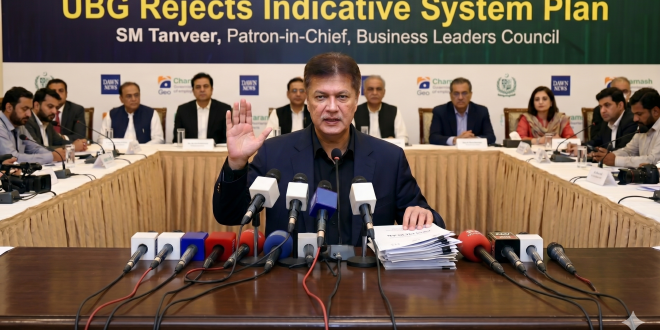
KARACHI, May 26, 2026: S.M. Tanveer, Patron-in-Chief of the United Business Group (UBG) and former caretaker provincial minister, has urged the National Electric Power Regulatory Authority (NEPRA) to reject the Indicative System Plan (ISP) 2025-35 and redesign what he called a deeply flawed energy roadmap.
In a statement, S.M. Tanveer said that Pakistan already has 40,000 MW of installed electricity generation capacity, while the country’s peak demand has fallen to 28,000 MW. He noted that grid demand has been declining for the past three years, while consumers have installed more than 45 GW of private solar panels. Despite this, he termed the proposal to add another 26,043 MW of generation capacity as incomprehensible.
S.M. Tanveer warned that “adding $57 billion in new power generation and transmission infrastructure to an already overburdened grid will not solve the crisis; it will only worsen it.”
He stated that 52.6% of every electricity bill currently goes toward capacity charges. According to Tanveer, Section 6.2.4 of the Independent System Market Operator’s (ISMO) document itself admits that the new plan would push electricity tariffs to historic and unaffordable levels.
Furthermore, he pointed out that weaknesses in the transmission system result in losses of 18% to 20% of generated electricity. Tanveer said that reducing these losses to the international standard of 10% could recover 19,000 GWh annually, saving more than Rs. 570 billion without any additional capital investment.
The UBG Patron-in-Chief also criticized the “PLEXOS” planning model, saying that mega projects such as Diamer Bhasha and Dasu had been preloaded as “must-run” projects, undermining genuine cost-optimized planning. Referring to WAPDA’s history of cost overruns, he noted that the Neelum-Jhelum project experienced a 3,300% increase in cost, while the Diamer Bhasha Dam’s cost has escalated to nearly Rs. 2,400 billion.
Although he acknowledged that dams and nuclear energy are important for long-term national sovereignty, he demanded that strict limits be imposed on their electricity cost components.
S.M. Tanveer stressed that any additional project costs should be borne by the government through the PSDP rather than being passed on to consumers through electricity bills.
He further said that the Federation of Pakistan Chambers of Commerce & Industry (FPCCI) and UBG believe electricity tariffs should be reduced from the current Rs. 33.38 per unit (12 cents) to the global benchmark of 9 cents, with a target of bringing tariffs down to 6 cents by 2035.
S.M. Tanveer urged the Prime Minister and NEPRA to send back ISP 2025 (IGCEP + TSEP) for revision, demanding corrected demand projections, transparent per-unit cost disclosures, and a binding cap on cost escalations in WAPDA projects.
He also said that Pakistan’s industry is on the brink of collapse and exporters are no longer competitive in global markets. “Pakistan cannot afford a plan that leads to its own financial destruction,” he concluded.