The Biz Update One of Pakistan's Most Reliable Business News Website
Related Articles


KARACHI, June 4, 2026: The Businessmen Panel Progressive (BMPP) has urged the government to prioritize export growth, industrial development, and expansion of the tax base in the upcoming federal budget, while reducing the cost of doing business by lowering the General Sales Tax (GST) to 15 percent and abolishing the Super Tax.
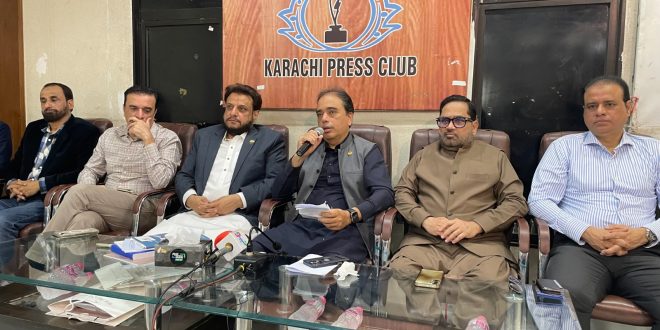
Addressing a press conference at the Karachi Press Club, BMPP Chairman and Senior Vice President of Federation of Pakistan Chambers of Commerce and Industry, Saquib Fayyaz Magoon, said the forthcoming budget should focus on export-led growth, tax reforms, and relief for the manufacturing sector. He stressed that reducing the cost of doing business and broadening the tax net were essential, while imposing additional taxes on already compliant sectors was counterproductive. FPCCI Vice Presidents Amanullah Paracha and Asif Sakhi, former Vice President Shabbir Mansha Churra, and other business leaders were also present.
Magoon said that if the government could not completely abolish the Super Tax, it should at least exempt the manufacturing sector to encourage investment and provide relief to industries. He maintained that burdening any single sector with additional taxes was not a sound policy and that all sectors should be treated equally.
He called for the restoration of the Fixed Tax Regime and measures to facilitate the inclusion of new taxpayers into the tax net. To simplify compliance, he proposed the introduction of a single-page tax return form that would be easier for businesses and small traders to understand and file.
Highlighting challenges facing the agricultural sector, Magoon demanded the withdrawal of taxes on cottonseed and special relief measures for the oilcake and cottonseed sectors. He also called for significant reductions in taxes on industrial raw materials to lower production costs and improve the competitiveness of Pakistani products in international markets, ultimately boosting exports.
He said FPCCI’s budget proposals place exports at the center of economic policy, arguing that increasing exports is essential for addressing Pakistan’s economic challenges. He urged the government to consult exporters and the business community on export-related policies and matters concerning the Final Tax Regime.
Expressing concerns over the proposed tax collection target of Rs15.2 trillion for the next fiscal year, Magoon described it as unrealistic and disconnected from economic realities. He noted that revenue targets had also been set unrealistically high in the previous fiscal year and were subsequently revised downward.
“Merely setting ambitious tax targets serves little purpose,” he said, adding that revenue goals should be based on the actual capacity of the economy and prevailing business activity. He stressed that tax collection targets should be determined in consultation with exporters and relevant stakeholders.
Magoon further stated that growth targets for different sectors should also be set through consultations with industry representatives and stakeholders. According to him, unilateral policymaking is ineffective and creates uncertainty within the business community.
Calling for extensive tax relief for the chemical industry, he said the sector has significant potential to contribute to industrial growth and exports. He also urged the government to review tax incentives available in the former FATA and PATA regions, ensuring that such concessions are aligned with local demand-and-supply conditions and economic realities to prevent misuse and maintain fair market competition.
Reiterating his concerns over the proposed Rs15.2 trillion tax target, Magoon said such goals do not reflect ground realities and have historically required downward revisions. He also called for tax and growth targets to be formulated through stakeholder consultations rather than unilateral decisions.
Among other proposals, he recommended exempting individuals earning up to Rs100,000 per month from income tax and increasing the minimum wage by 15 percent in view of rising inflation. He also advocated special tax incentives for the chemical industry and a comprehensive review of tax concessions granted to FATA and PATA.
Speaking on the occasion, Shabbir Mansha Churra said the federal budget should focus on economic growth rather than revenue targets alone. Asif Sakhi emphasized the need to make trade bodies partners in policy implementation, while Amanullah Paracha stressed that economic growth would remain elusive without broadening the tax base and simplifying the tax system to make it more business-friendly and less intimidating.