 The Biz Update One of Pakistan's Most Reliable Business News Website
Related Articles


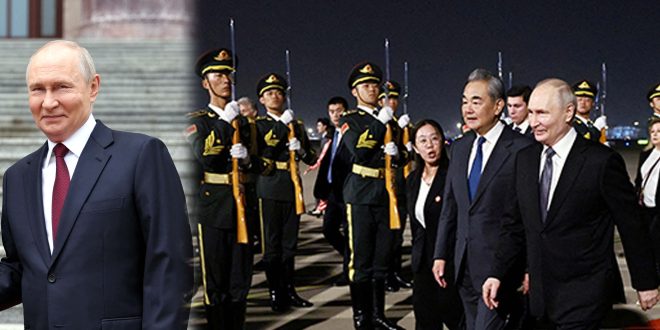
KARACHI ,May 21 ,2026:Relations among major powers such as the United States, China, and Russia go far beyond formal diplomatic meetings. Instead, political, economic, strategic, and security factors continuously shape their interactions. Recently, Russian President Vladimir Putin visited China and met President Xi Jinping. As a result, discussions on global power shifts and the future world order resurfaced.
During their meeting in Beijing, both leaders addressed global developments, bilateral cooperation, and international stability. Xi Jinping raised concerns over rising global tensions and the growing use of power in international affairs. Meanwhile, Vladimir Putin described Russia–China relations as stable and strategically important. Analysts now interpret these remarks in the context of shifting global politics.
At the same time, Western powers, including the United States, Britain, France, and Germany, continue to defend the existing international system and their strategic interests. In contrast, China and Russia push for a more multipolar world order. Therefore, analysts increasingly link Moscow–Beijing cooperation to changing global power dynamics.
Moreover, both Russia and China face ongoing tensions with the West. Russia continues to deal with sanctions and diplomatic pressure due to the Ukraine conflict. Similarly, China faces disputes over Taiwan, trade restrictions, and technological competition with the United States and its allies. Consequently, both countries are strengthening cooperation based on shared strategic interests.
During the visit, Chinese authorities gave Putin a high-level state reception. Foreign Minister Wang Yi received him, and China granted full protocol treatment. In diplomacy, such gestures often signal the importance and direction of bilateral relations.
However, global politics cannot be reduced to a simple “US versus China and Russia” framework. In reality, the global economy remains deeply interconnected. Therefore, full decoupling or confrontation could seriously disrupt global financial stability. China continues strong trade relations with the United States, the European Union, Japan, and South Korea. Meanwhile, Russia remains a key player in global energy markets.
In addition, China closely monitors developments in the Middle East due to their impact on energy security. It consistently supports ceasefires, dialogue, and regional stability. Likewise, Russia views the Middle East as strategically important for both energy and geopolitics.
Finally, many analysts question whether the world is moving into a more fragmented and power-driven era. Today, influence no longer depends only on military strength. Instead, economic sanctions, cyber tools, information warfare, technology, and diplomacy all play major roles. As a result, countries increasingly build new alliances and regional partnerships to protect their interests.

