The Biz Update One of Pakistan's Most Reliable Business News Website
Related Articles
KARACHI, October 2, 2026: Al-Ghazi Tractors Limited (AGTL) has called for smarter and more accessible farm mechanisation to improve agricultural productivity and strengthen food security in Pakistan.
The company made the case during the Pakistan Agricultural Coalition’s (PAC) Agri-Connections Conference & Expo 2026, where AGTL served as the Platinum Sponsor.
Held on October 1 and 2 at the Lahore Expo Centre in partnership with the Government of Punjab, the conference focused on “Food Security and Agri-Investment in the Era of Climate Change.”
The event brought together policymakers, development institutions, agribusiness leaders, financial institutions and farmers. The World Bank, International Finance Corporation (IFC) and Food and Agriculture Organisation of the United Nations (FAO) participated as strategic partners.
Speaking on the first day, AGTL Chief Executive Officer Yasin Seker highlighted four major challenges facing Pakistan’s agriculture sector. These include lower crop yields compared with regional benchmarks, rising food demand, increasing input costs for small farmers and growing pressure from irregular monsoons, heat stress and water shortages.
Seker said modern mechanisation can help farmers improve productivity while using inputs more efficiently. He also highlighted AGTL’s manufacturing experience since 1983 at its Dera Ghazi Khan plant, along with its focus on local production, supplier development, rural skills and a nationwide service network.
“For decades, Pakistani farmers have asked for dependable horsepower at an affordable price. That remains essential, but their needs are changing,” Seker said.
He said farmers now need greater productivity, machine reliability, efficient use of inputs and support throughout the life of agricultural machinery.
Seker identified telematics and precision guidance as two technologies with strong potential for immediate adoption. Telematics can help monitor machine health, provide maintenance alerts and track machine usage. Precision guidance and automatic steering can reduce overlapping field operations and improve the accuracy of seed, fertiliser and chemical applications.
However, he stressed that technology adoption should remain farmer-led and focused on measurable returns.
AGTL’s proposed approach starts with strengthening basic mechanisation and after-sales services. The company then recommends piloting high-value technologies, testing their economic benefits at farm level and expanding only those solutions that demonstrate clear returns for farmers.
“Technology must follow value, not the other way round. If a solution cannot prove its worth on a farmer’s own field, it has no business being scaled,” Seker said.
On the second day, Seker participated in a panel discussion titled “The Future of Technology in Agriculture.” He called for Pakistan to move beyond conventional tractorisation towards an integrated agricultural technology ecosystem involving machinery, precision technologies and digital tools.
He also pointed to the financial challenges facing farmers. With many farms in Pakistan being small, farmers may not be able to purchase every type of agricultural machine. Seker said custom hiring, machinery rental, leasing and mechanisation-as-a-service models could provide farmers with access to modern equipment without requiring full ownership.
He further called for coordinated efforts among farmers, manufacturers, dealers, government, financial institutions, technology providers and development organisations.
According to Seker, affordable equipment financing, crop insurance, effective extension services and technologies adapted to local conditions will be important for wider adoption.
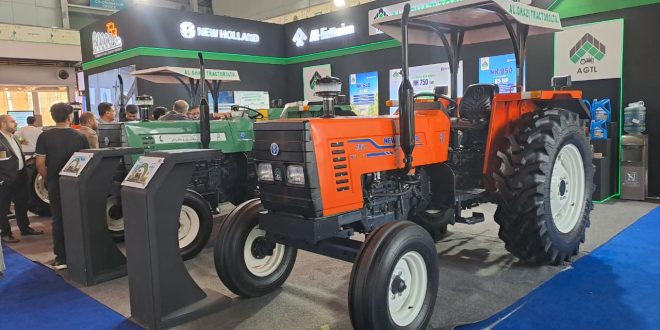
At its exhibition stall, AGTL showcased New Holland tractors to visitors from across Pakistan’s agricultural value chain.
The company’s Platinum sponsorship follows its decision in June 2026 to join PAC as a Patron. Through the partnership, AGTL aims to contribute its more than four decades of experience in manufacturing New Holland tractors in Pakistan to efforts aimed at building a more productive, technology-driven and competitive agriculture sector.