The Biz Update One of Pakistan's Most Reliable Business News Website
Related Articles


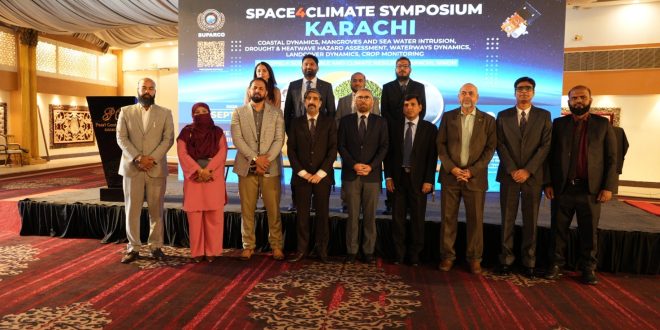
KARACHI, September 9, 2026: The Pakistan Space and Upper Atmosphere Research Commission (SUPARCO) held its fourth regional symposium under the Space4Climate Initiative in Karachi on September 8.
The event was organized through SUPARCO’s Space Applications Center for Climate Sciences (SACCS) at the PC Hotel. It focused on the use of space technology to monitor climate change and strengthen climate resilience.
The symposium brought together senior government officials, policymakers, scientists, researchers, development partners, academics and environmental experts. Participants discussed ways to expand the use of satellite data for climate monitoring and evidence-based policymaking.
The event was part of SUPARCO’s seven-city National and Provincial Symposium Series. The series is being held in Islamabad, Lahore, Karachi, Peshawar, Quetta, Gilgit and Muzaffarabad. The first symposium took place in Peshawar on July 23, followed by Gilgit on August 5 and Lahore on August 27.
During the opening session, Dr. Mohammad Farooq, Deputy Director General of SACCS, introduced the Space4Climate Initiative. Ali Kamran, Member Technology Wing, SUPARCO, delivered the welcome remarks.
Secretary of Environment, Climate Change and Coastal Development, Government of Sindh, Faisal Ahmed Uqaili, attended the event as keynote speaker. He stressed the need to integrate advanced geospatial technologies into climate governance and disaster risk reduction.
Uqaili also called for stronger cooperation among institutions. He said scientific data should guide climate adaptation, environmental protection and national resilience. He highlighted Sindh government initiatives related to carbon monitoring, carbon financing and Nationally Determined Contributions (NDCs), as well as 13 projects launched to address climate change.
Zafar Iqbal, Member Space Application and Research Wing, SUPARCO, attended the symposium as chief guest. He highlighted the growing impact of climate change across Pakistan, including glacier melt, floods, droughts, heatwaves and air pollution.
He also pointed to increasing pressure on agriculture and water resources. According to Iqbal, Earth observation satellites, remote sensing, geospatial analytics and Geographic Information Systems (GIS) are now essential for monitoring environmental changes.
He said SUPARCO is working to convert satellite data into practical climate intelligence. This information can support national priorities in areas such as disaster risk reduction, water management, food security and environmental protection.
A major feature of the symposium was a live demonstration of SUPARCO’s Space4Climate Geospatial Portals. The portals use satellite data to provide near-real-time information on greenhouse gases, air quality, glaciers, snow cover, waterways, land cover and coastal ecosystems.
The system uses data from Pakistan’s satellite assets, including PRSS-1, SAR-1, the EO series and hyperspectral capabilities. The information can help government institutions make faster and more informed decisions.
Technical sessions covered waterways and land-cover dynamics, crop monitoring, air quality, environmental assessment and heatwave hazards. Experts discussed how satellite-based information can support agriculture, water management, urban planning, disaster preparedness and environmental protection in Sindh.
An interactive panel discussion focused on mainstreaming space-based information into provincial planning and development. Participants stressed the need for stronger coordination among government agencies and wider access to geospatial information.
They also called for satellite-based climate services to become part of planning, disaster preparedness, natural resource management and environmental governance.
The symposium concluded with recommendations to expand the institutional use of Space4Climate services across government departments. Participants also called for stronger cooperation between scientific and government organizations and greater capacity building in geospatial technologies.
The event concluded with remarks by Raheem Sanaullah Chaudhry, Member Space Electronics Wing, SUPARCO.
The symposium reflects SUPARCO’s continued efforts to use space science and technology for peaceful applications. These efforts support climate resilience, environmental sustainability and national development, while also contributing to Pakistan’s commitments under the Sustainable Development Goals, Paris Agreement and Sendai Framework for Disaster Risk Reduction.